
Items
Miracleman #10 (P)
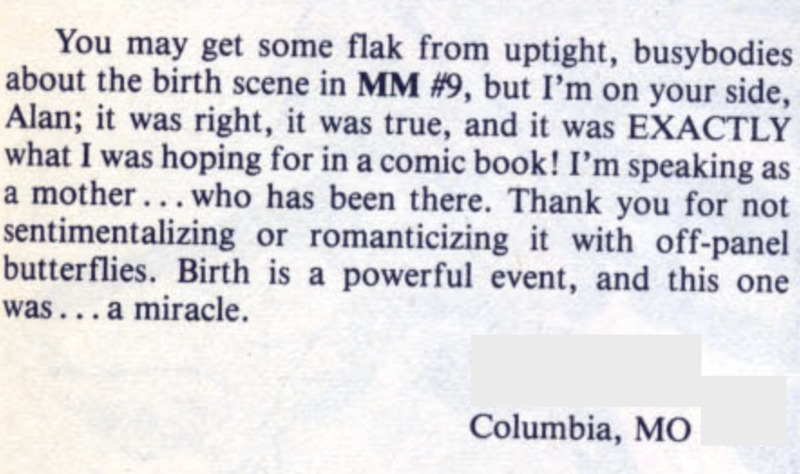
Fan letter written to Miracleman #10.
Transcribed text:
You may get some flak from uptight, busybodies about the birth scene in MM #9, but I’m on your side, Alan; it was right, it was true, and it was EXACTLY what I was hoping for in a comic book! I’m speaking as a mother... who has been there. Thank you for not sentimentalizing or romanticizing it with off-panel butterflies. Birth is a powerful event, and this one was... a miracle.
Columbia, MO
Miracleman #10 (F)
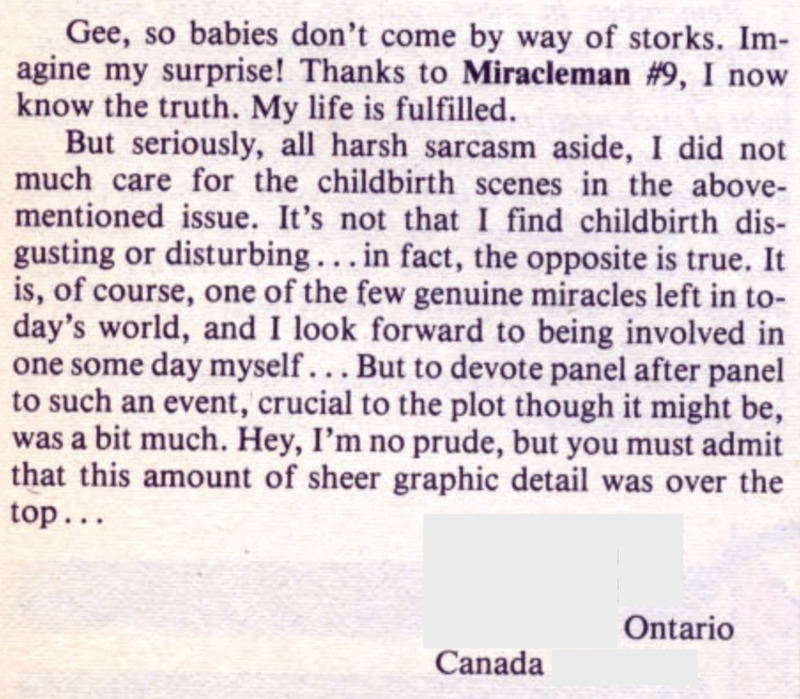
Fan letter written to Miracleman #10.
Transcribed text:
Gee, so babies don't come by way of storks. Imagine my surprise! Thanks to Miracleman #9, I now know the truth. My life is fulfilled.
But seriously, all harsh sarcasm aside, I did not much care for the childbirth scenes in the above-mentioned issue. It’s not that I find childbirth disgusting or disturbing... in fact, the opposite is true. It is, of course, one of the few genuine miracles left in today’s world, and I look forward to being involved in one some day myself... But to devote panel after panel to such an event, crucial to the plot though it might be, was a bit much. Hey, I’m no prude, but you must admit that this amount of sheer graphic detail was over the top...
Ontario, Canada
Miracleman #10 (B)
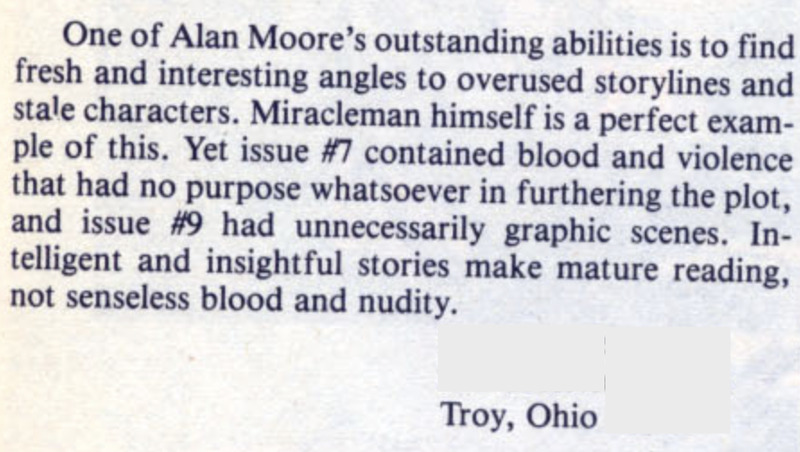
Fan letter written to Miracleman #10.
Transcribed text:
One of Alan Moore's outstanding abilities is to find fresh and interesting angles to overused storylines and stale characters. Miracleman himself is a perfect example of this. Yet issue #7 contained blood and violence that had no purpose whatsoever in furthering the plot, and issue #9 had unnecessarily graphic scenes. Intelligent and insightful stories make mature reading, not senseless blood and nudity.
Troy, Ohio
Miracleman #6 (S)
Fan letter written to Miracleman #6.
Transcribed text:
Dear Eclipse team:
Jim Starlin’s cover to #4 was pretty frightening. Miracleman looks like the ultimate Aryan monster—I suppose this is how Sir Dennis [Archer] sees him.
The reproduction on this issue was much better than in previous issues, and the colors—particularly for Miracleman’s outfit—are much more brilliant. Good job.
Thanks for publishing the Miracleman 3-D Special. This is the only reprint material of the series that I had not yet seen. While nothing in the Special seems to be of any immediate importance to the storyline occurring in the regular magazine, the old stuff adds a sense of depth, of history to the character. While the purple perspective blocks distracted horribly from Mick Austin’s great cover art, the splash page was really nice—who was the artist here?
As for the 3-D effect, Ray Zone did a good job, as he has on everything that I’ve seen which he has handled. Meanwhile, 3-D isn’t all that great an attraction for me—the novelty just isn’t that appealing. From a marketing standpoint, though, your strategy appears sound: Miracleman completists like me would buy the Special anyway; people who are intrigued by 3-D and who haven't bought MM before now may be led to try the regular book as well. Anyway, I hope it works out that nicely for you, but I’ve kinda had my fill of 3-D books for awhile, okay?
By the way, a text page either introducing the character or explaining the context would have been good to include in the Special for those readers who haven’t encountered MM previously. Just a helpful hint, y’know.
Lexington KY
Miracleman #6 (R)
Fan letter written to Miracleman #6.
Transcribed text:
Dear Alan,
Not having had the pleasure of reading the original run of Miracleman in Warrior, these Miracleman stories are all new to me, and may I say that I'm quite impressed! But I'm sure that by now you've received thousands of letters telling you how great Miracleman is and how much everyone loves the work you and Alan Davis are doing. So I won't tell you again what is so great about Miracleman. I won't bore you by telling you again how vivid the artwork is and how delightfully subtle the writing is. I just want to tell you why I like Miracleman so much.
In MM #2, while discussing the genesis of your version of Miracleman, you said that you were "struck by the image of the eternally youthful and exuberant hero as a middle-aged man trudging the streets and trying fruitlessly to remember his magic word." I think that image is something we can all identify with. Although the difference is not so extreme for us as it is for Mike/MM, somedays we just "trudge the streets" while others we fly high, a "youthful and exuberant hero." Miracleman lets us see that hero within ourselves and, just a little bit (how much can we ask for just 75¢?), he pulls that hero out of us! Yet, don't we all sometimes feel that there is a superhero of some sort lurking within the depths of our being and maybe, just maybe, someday we might accidentally say our magic word?
Isn't that what we're all striving for? To remember our magic word?
Kimota!
Shucks. It didn't work.
Los Angeles CA
Miracleman #6 (A)
Fan letter written to Miracleman #6.
Transcribed text:
Dear Editor,
I suppose my first order of business is to ask who writes the letter pages. I guess I've become spoiled by many of the books that feature “signed” letter pages. It seems to make things a bit more personal. My assumption is that the page is handled by catherine yronwode. This might be a wrong assumption, though. Unless you have a reason not to place your name on your work (it doesn't have to be a good reason), please let us know to whom we are speaking. Thanks.
Now on to Miracleman #4. Jim Starlin's cover was nice. I got a kick out of the familiar bust on the bookshelf behind Miracleman. As I said, I thought the cover was nice, but neither it nor Howard Chaykin's cover for issue #3 caught the full power of the fine work inside the book. (This is definitely not true of Mick Austin's wonderful painting on the cover of the Miracleman 3-D Special.) Just the same, I'm looking forward to Paul Gulacy's treatment next month.
In terms of writing, what could I say about Alan Moore that hasn't been said many times over by many comic readers and critics. Having not read Alan's Swamp Thing stories, this is my first series exposure to his writing. I find it very mature and thoughtful. As such it is thought-provoking. After being disappointed by others' claims, it is good to finally read an adult superhero comic.
The art by Alan Davis is a perfect match for Alan Moore's writing. So was Garry Leach's. It is rare that so fine an artist succeeds another fine artist. I hope the new stories featuring Chuck Beckum's art is as appropriate.
Congratulations on a QUALITY-filled run so far, and here's hoping that your new stories continue to ECLIPSE the competition.
Cincinnati OH
Miracleman #4 (F)
Fan letter written to Miracleman #4.
Dear Alan:
I pity those poor comic fans who missed out on Miracleman no. 1. They may believe that it’s not worth the effort (and money) to pick it up, especially now that issue no. 2 is out. I think they are making a big mistake. Miracleman is miraculous. It is, by far, the best title to debut in 1985. But my enjoyment of it goes beyond that... I honestly believe it is one of the best titles, period. Yes, there have only been two issues so far, but as this is a reprint (I wonder how many collectors even realize that simple fact?), we know things are going to get even better. You know I’ll be sticking around, and I think there will be a lot of us, eventually (assuming the current issue stockpiling rage dies down).
No comic is perfect, however, and I do have a few quibbles to voice. The cover logo is pretty sad... it’s somewhat garish, don’t you think? I think something a little more subdued is in order. Ron Fontes’ Void Indigo logo (that comic’s only redeeming factor) is a good example. MIRACLEMAN deserves to have a unique, dramatic logo instead of something that looks like it was designed in five minutes. I’m sure co-creator Alan Davis could be persuaded to come up with a suggestion or two.
This brings me to my second point. Why don’t you give Mr. Davis cover credit? As far as I’m concerned, the penciller is more important than the inker when it comes to comic art, and yet inker Garry Leach, talented though he may be, is the only name to appear.
My final quibble is a simple one... how about some pagination, hmm? I realize that the pages of original art are not numbered, but I think it would be easy to get your typesetter to tap out a few numbers which you could include in a nice subtle manner at the bottom of each page. A minor point perhaps, but it became rather noticeable at the bottom of the first page of your editorial, in which readers are told the article is continued on page 31. Of course, with no pagination, we have no idea where page 31 is. I think you can see the problem here, and I hope you decide to rectify it soon.
So much for that. I’ll finish this letter in a moment, but I wish to add that since MIRACLEMAN will inspire a LOT of letters from your readers (this is just one of several) you are therefore going to need a letters page. The obvious choice for a name for such a page would be “Miraclemail”. Sometimes the obvious choice is the best choice, so that will be my suggestion.
Thank for listening. I wish you much success... but then, you’ve already GOT that, don’t you? OK then, continued success!
Sudbury, Ontario
Canada
Miracleman #3 (K)
Fan letter written to Miracleman #3.
Transcribed text:
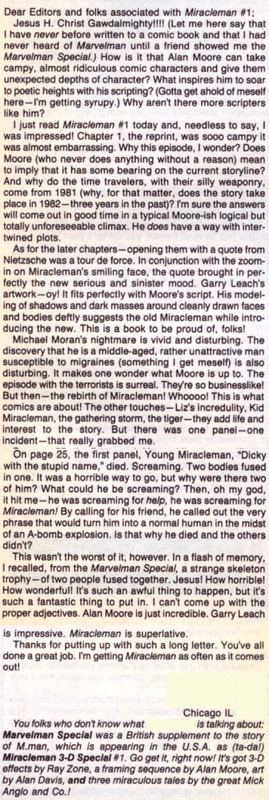
Dear Editors and folks associated with Miracleman #1;
Jesus H. Christ Gawdalmighty!!!! (Let me here say that I have never before written to a comic book and that I had never heard of Marvelman until a friend showed me the Marvelman Special.) How is it that Alan Moore can take campy, almost ridiculous comic characters and give them unexpected depths of character? What inspires him to soar to poetic heights with his scripting? (Gotta get ahold of meself here—I’m getting syrupy.) Why aren’t there more scripters like him?
I just read Miracleman #1 today and, needless to say, I was impressed! Chapter 1, the reprint, was sooo campy it was almost embarrassing. Why this episode, I wonder? Does Moore (who never does anything without a reason) mean to imply that it has some bearing on the current storyline? And why do the time travelers, with their silly weaponry, come from 1981 (why, for that matter, does the story take place in 1982—three years in the past)? I’m sure the answers will come out in good time in a typical Moore-ish logical but totally unforeseeable climax. He does have a way with intertwined plots.
As for the later chapters—opening them with a quote from Nietzsche was a tour de force. In conjunction with the zoom-in on Miracleman’s smiling face, the quote brought in perfectly the new serious and sinister mood. Garry Leach’s artwork—oy! It fits perfectly with Moore’s script. His modeling of shadows and dark masses around cleanly drawn faces and bodies deftly suggests the old Miracleman while introducing the new. This is a book to be proud of, folks!
Michael Moran’s nightmare is vivid and disturbing. The discovery that he is a middle-aged, rather unattractive man susceptible to migraines (something I get meself) is also disturbing. It makes one wonder what Moore is up to. The episode with the terrorists is surreal. They’re so businesslike! But then—the rebirth of Miracleman! Whoooo! This is what comics are about! The other touches—Liz’s incredulity, Kid Miracleman, the gathering storm, the tiger—they add life and interest to the story. But there was one panel—one incident—that really grabbed me.
On page 25, the first panel, Young Miracleman, “Dicky with the stupid name,” died. Screaming. Two bodies fused in one. It was a horrible way to go, but why were there two of him? What could he be screaming? Then, oh my god, it hit me—he was screaming for help, he was screaming for Miracleman! By calling for his friend, he called out the very phrase that would turn him into a normal human in the midst of an A-bomb explosion. Is that why he died and the others didn’t?
This wasn’t the worst of it, however. In a flash of memory, I recalled, from the Marvelman Special, a strange skeleton trophy—of two people fused together. Jesus! How horrible! How wonderful! It’s such an awful thing to happen, but it’s such a fantastic thing to put in. I can’t come up with the proper adjectives. Alan Moore is just incredible. Garry Leach is impressive. Miracleman is superlative.
Thanks for putting up with such a long letter. You’ve all done a great job. I’m getting Miracleman as often as it comes out!
Chicago IL
You folks who don’t know what [redacted] is talking about: Marvelman Special was a British supplement to the story of M.man, which is appearing in the U.S.A. as (ta-da!) Miracleman 3-D Special #1. Go get it, right now! It’s got 3-D effects by Ray Zone, a framing sequence by Alan Moore, art by Alan Davis, and three miraculous tales by the great Mick Anglo and Co.!
Miracleman #3 (H)
Fan letter written to Miracleman #3.
Transcribed text:
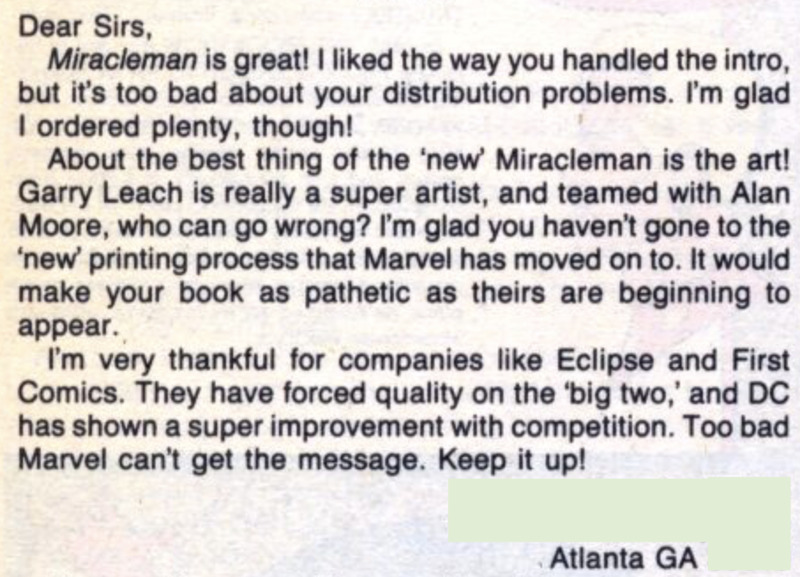
Dear Sirs,
Miracleman is great! I liked the way you handled the intro, but it's too bad about your distribution problems. I'm glad I ordered plenty, though!
About the best thing of the 'new' Miracleman is the art! Garry Leach is really a super artist, and teamed with Alan Moore, who can go wrong? I'm glad you haven't gone to the 'new' printing process that Marvel has moved on to. It would make your book as pathetic as theirs are beginning to appear.
I'm very thankful for companies like Eclipse and First Comics. They have forced quality on the 'big two,' and DC has shown a super improvement with competition. Too bad Marvel can't get the message. Keep it up!
Atlanta GA
Miracleman #3 (C)
Fan letter written to Miracleman #3.
Transcribed text:
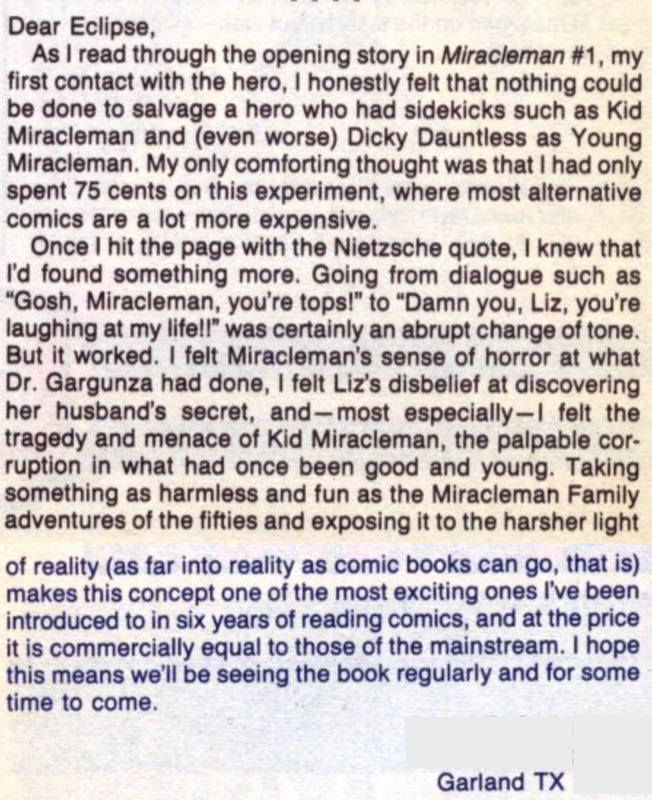
Dear Eclipse,
As I read through the opening story in Miracleman #1, my first contact with the hero, I honestly felt that nothing could be done to salvage a hero who had sidekicks such as Kid Miracleman and (even worse) Dicky Dauntless as Young Miracleman. My only comforting thought was that I had only spent 75 cents on this experiment, where most alternative comics are a lot more expensive.
Once I hit the page with the Nietzsche quote, I knew that I'd found something more. Going from dialogue such as "Gosh, Miracleman, you're tops!" to "Damn you, Liz, you're laughing at my life!!" was certainly an abrupt change of tone. But it worked. I felt Miracleman's sense of horror at what Dr. Gargunza had done, I felt Liz's disbelief at discovering her husband's secret, and—most especially—I felt the tragedy and menace of Kid Miracleman, the palpable corruption in what had once been good and young. Taking something as harmless and fun as the Miracleman Family adventures of the fifties and exposing it to the harsher light of reality (as far into reality as comic books can go, that is) makes this concept one of the most exciting ones I've been introduced to in six years of reading comics, and at the price it is commercially equal to those of the mainstream. I hope this means we'll be seeing the book regularly and for some time to come.
Garland TX
Miracleman #3 (BS)
Fan letter written to Miracleman #3.
Transcribed text:
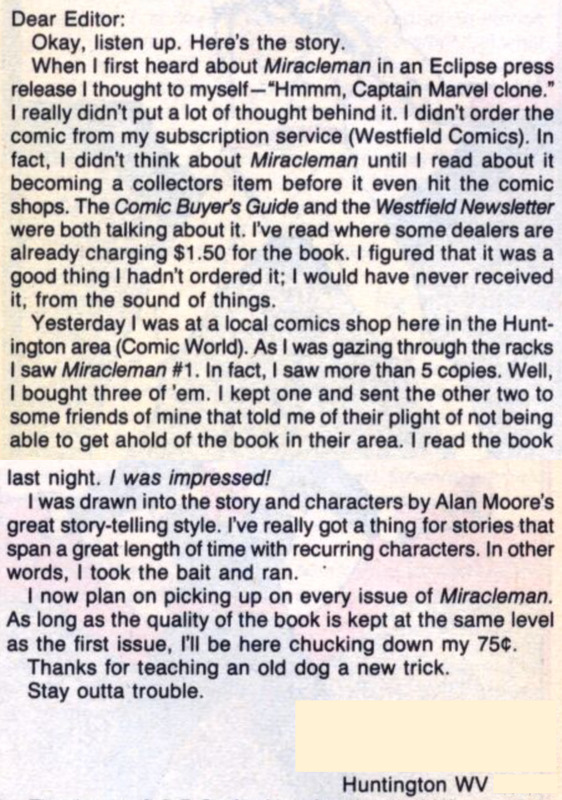
Dear Editor:
Okay, listen up. Here's the story.
When I first heard about Miracleman in an Eclipse press release I thought to myself—"Hmmm, Captain Marvel clone." I really didn't put a lot of thought behind it. I didn't order the comic from my subscription service (Westfield Comics). In fact, I didn't think about Miracleman until I read about it becoming a collectors item before it even hit the comic shops. The Comic Buyer's Guide and the Westfield Newsletter were both talking about it. I've read where some dealers are already charging $1.50 for the book. I figured that it was a good thing I hadn't ordered it; I would have never received it, from the sound of things.
Yesterday I was at a local comics shop here in the Huntington area (Comic World). As I was gazing through the racks I saw Miracleman #1. In fact, I saw more than 5 copies. Well, I bought three of 'em. I kept one and sent the other two to some friends of mine that told me of their plight of not being able to get ahold of the book in their area. I read the book last night. I was impressed!
I was drawn into the story and characters by Alan Moore's great story-telling style. I've really got a thing for stories that span a great length of time with recurring characters. In other words, I took the bait and ran.
I now plan on picking up on every issue of Miracleman. As long as the quality of the book is kept at the same level as the first issue, I'll be here chucking down my 75¢.
Thanks for teaching an old dog a new trick.
Stay outta trouble.
Huntington WV
Miracleman #3 (B)
Fan letter written to Miracleman #3.
Transcribed text:
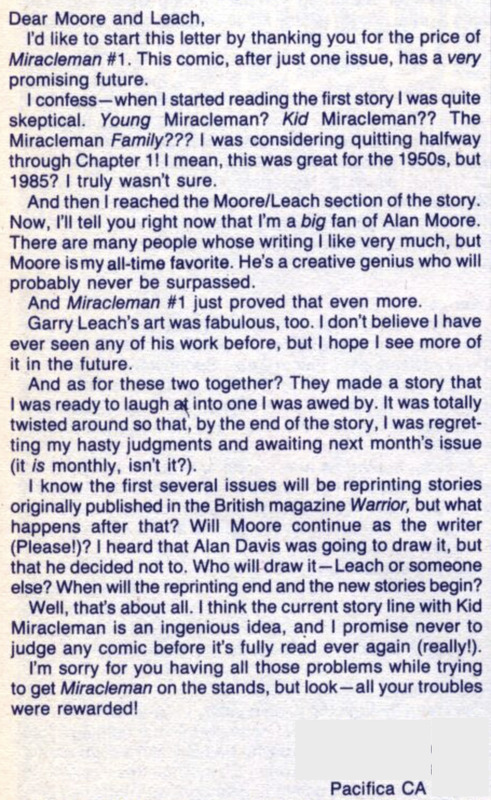
Dear Moore and Leach,
I'd like to start this letter by thanking you for the price of Miracleman #1. This comic, after just one issue, has a very promising future.
I confess—when I started reading the first story I was quite skeptical. Young Miracleman? Kid Miracleman?? The Miracleman Family??? I was considering quitting halfway through Chapter 1! I mean, this was great for the 1950s, but 1985? I truly wasn't sure.
And then I reached the Moore/Leach section of the story. Now, I'll tell you right now that I'm a big fan of Alan Moore. There are many people whose writing I like very much, but Moore is my all-time favorite. He's a creative genius who will probably never be surpassed.
And Miracleman #1 just proved that even more.
Garry Leach's art was fabulous, too. I don't believe I have ever seen any of his work before, but I hope I see more of it in the future.
And as for these two together? They made a story that I was ready to laugh at into one I was awed by. It was totally twisted around so that, by the end of the story, I was regretting my hasty judgments and awaiting next month's issue (it is monthly, isn't it?).
I know the first several issues will be reprinting stories originally published in the British magazine Warrior, but what happens after that? Will Moore continue as the writer (Please!)? I heard that Alan Davis was going to draw it, but that he decided not to. Who will draw it—Leach or someone else? When will the reprinting end and the new stories begin?
Well, that's about all. I think the current story line with Kid Miracleman is an ingenious idea, and I promise never to judge any comic before it's fully read ever again (really!).
I'm sorry for you having all those problems while trying to get Miracleman on the stands, but look—all your troubles were rewarded!
Pacifica CA

Warrior #25 (M)
Fan letter written to Warrior #25.
Transcribed text:
Dear Dez and Co.,
I’ve just finished reading issues 14–16 and I guess the first thing I should say is that your foreign distribution hasn’t improved, at least not around here anyway. Warrior is still not carried by my local comics shop (I’ve asked and they say that their distributor doesn’t carry it), thus I must seek it out elsewhere (which is why I end up getting several issues at once). Also, as far as timing goes, the issues seem to appear about three months after the cover date here (however that compares to UK distribution). However, you continue to produce a publication that makes these inconveniences inconsequential in comparison.
I was pleased to read in issue 16 that here is the possibility of releasing reprint series of Warrior features in the American market, as this will increase your exposure (and, presumably, revenues—which do come in handy at times). However, I was interested at your phrasing: ‘... the plan is to produce both the black and white Warrior for the discerning reader, and colour comic reprints for the U.S. fans.’ Does this mean that US fans aren't discerning? (Gosh, this is one of those times I’m glad I’m not an American; I might be offended.) But seriously, I think the relative lack of success of black and white publications can also be attributed to other factors. For instance, distribution is not as good (witness your own case) and because the market is geared to the standard format, the dealers can’t or won’t display the magazines effectively. It’s sort of a case of Catch-22 critical mass: Black and white isn’t successful as a rule because it’s not the standard (i.e., because it’s not successful). I must also disagree, in part, with your contention that non-standard publications don’t ‘register’ with the ‘Fan’. Cerebus and Elfquest, both black and white with the latter even being magazine-size, have been considerable fan successes, though not in the casual-reader market (largely, again, due to lack of distribution there).
The strip showing the biggest improvement in the most recent three issues has been Shandor. These stories showed his courage and commitment but, even more, they gave a good appreciation of the nature of his enemies. Too often, supernatural stories portray demons as just another variety of Bad Guy, that have magical powers, but here we saw they are indeed in a class by themselves. Their power and treachery were very well portrayed, as were the peculiar restraints under which the ‘game’ is played. And the demons play the game like all people of ill will do: They obey the letter of the law as required and enforced but try at every turn to avoid the spirit of the law. That they were just toying with Shandor was a shocking revelation, but perhaps this is just one small learning experience for him in his struggle.
The best strips have continued to be Marvelman and V, about which I am momentarily bereft of suitable laudatory words. Laser Eraser and Pressbutton seem to be on a bit of a sabbatical, with only one new story in the three issues, but it was a promising one. Twilight World is a welcome addition to the regular lineup. The key aspect that I would like further developed in it is the nature of the relationship between the alien and the human. It was called a symbiotic relationship in issue 14, but the exact nature of the benefits received by each partner have not really been explained.
The behind-the-scenes text pieces have been both informative and enjoyable, if perhaps a little too ‘cutesy’ at times.
Weston, Ontario, Canada

Warrior #25 (E)
Fan letter written to Warrior #25.
Transcribed text:
Dear Dez,
I have not written before because it didn't seem to be my business to stick up for another adult, who seemed perfectly able to speak for himself. But as Warrior continues its attack, and does not print replies, which from the character of the man revealed in his letters, he must be sending, I am doing so. Not only to defend him, but more importantly, to point out that the editorial attitude shown on the letters pages, if allowed to spill over into the rest of Warrior will poison it. Because the rest of Warrior is adult and beautifully balanced, which the letters pages certainly are not.
In an early issue of Warrior you printed a letter from Francis Hertzberg which pointed out that many of the facts you gave about Marvelman were not facts at all. You snubbed him by saying you preferred to rely on Mick Anglo's memory. I have recently had the chance to see some of the last Captain Marvel and first Marvelman issues, and Francis Hertzberg is quite correct, Mick Anglo's memory was wrong, and so were your 'facts'.
In a more recent issue he pointed out a few coincidences between Marvelman and other publications. I took these to be a rather pleasant child-like enjoyment of discovery, but your substitute editor went for him in a most vicious way, which was totally uncalled-for.
I suspect you will not use this letter, as it goes against your grain, or if you do, that you will cut it to ribbons, or alternatively print the inevitable shoals of attacks from people who have not bothered to read it but think they know what it says without doing so. I hope in that case I shall have the strength of character not to waste another two hours writing a further letter!
Liverpool
Warrior #18 (B)
Fan letter written to Warrior #18.
Transcribed text:
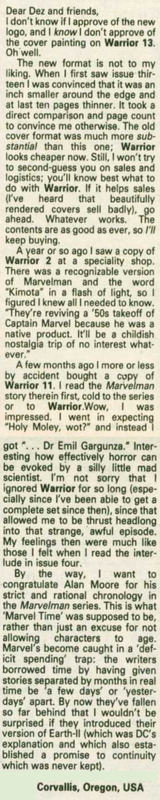
Dear Dez and friends,
I don't know if I approve of the new logo, and I know I don't approve of the cover painting on Warrior 13. Oh well.
The new format is not to my liking. When I first saw issue thirteen I was convinced that it was an inch smaller around the edge and at last ten pages thinner. It took a direct comparison and page count to convince me otherwise. The old cover format was much more substantial than this one; Warrior looks cheaper now. Still, I won't try to second-guess you on sales and logistics; you'll know best what to do with Warrior. If it helps sales (I've heard that beautifully rendered covers sell badly), go ahead. Whatever works. The contents are as good as ever, so I'll keep buying.
A year or so ago I saw a copy of Warrior 2 at a speciality shop. There was a recognizable version of Marvelman and the word "Kimota" in a flash of light, so I figured I knew all I needed to know. "They're reviving a '50s takeoff of Captain Marvel because he was a native product. It'll be a childish nostalgia trip of no interest whatever."
A few months ago I more or less by accident bought a copy of Warrior 11. I read the Marvelman story therein first, cold to the series or to Warrior. Wow, I was impressed. I went in expecting "Holy Moley, wot?" and instead I got "... Dr Emil Gargunza." Interesting how effectively horror can be evoked by a silly little mad scientist. I'm not sorry that I ignored Warrior for so long (especially since I've been able to get a complete set since then), since that allowed me to be thrust headlong into that strange, awful episode. My feelings then were much like those I felt when I read the interlude in issue four.
By the way, I want to congratulate Alan Moore for his strict and rational chronology in the Marvelman series. This is what 'Marvel Time' was supposed to be, rather than just an excuse for not allowing characters to age. Marvel's become caught in a 'deficit spending' trap: the writers borrowed time by having given stories separated by months in real time be 'a few days' or 'yesterdays' apart. By now they've fallen so far behind that I wouldn't be surprised if they introduced their version of Earth-II (which was DC's explanation and which also established a promise to continuity which was never kept).
Corvallis, Oregon, USA
Warrior #10 (W)
Fan letter written to Warrior #10.
Transcribed text:
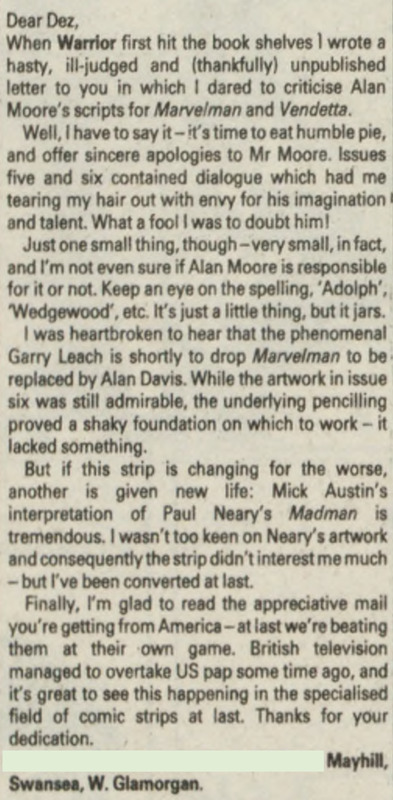
Dear Dez,
When Warrior first hit the book shelves I wrote a hasty, ill-judged and (thankfully) unpublished letter to you in which I dared to criticise Alan Moore's scripts for Marvelman and Vendetta.
Well, I have to say it—it's time to eat humble pie, and offer sincere apologies to Mr Moore. Issues five and six contained dialogue which had me tearing my hair out with envy for his imagination and talent. What a fool I was to doubt him!
Just one small thing, though—very small, in fact, and I'm not even sure if Alan Moore is responsible for it or not. Keep an eye on the spelling, 'Adolph', 'Wedgewood', etc. It's just a little thing, but it jars.
I was heartbroken to hear that the phenomenal Garry Leach is shortly to drop Marvelman to be replaced by Alan Davis. While the artwork in issue six was still admirable, the underlying pencilling proved a shaky foundation on which to work—it lacked something.
But if this strip is changing for the worse, another is given new life: Mick Austin's interpretation of Paul Neary's Madman is tremendous. I wasn't too keen on Neary's artwork and consequently the strip didn't interest me much—but I've been converted at last.
Finally, I'm glad to read the appreciative mail you're getting from America—at last we're beating them at their own game. British television managed to overtake US pap some time ago, and it's great to see this happening in the specialised field of comic strips at last. Thanks for your dedication.
Mayhill, Swansea, W. Glamorgan
Warrior #10 (L)
Fan letter written to Warrior #10.
Transcribed text:
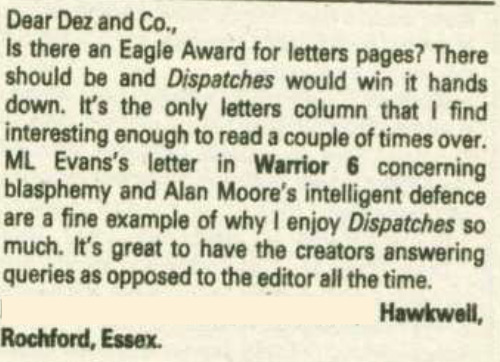
Dear Dez and Co.,
Is there an Eagle Award for letters pages? There should be and Dispatches would win it hands down. It’s the only letters column that I find interesting enough to read a couple of times over. ML Evans's letter in Warrior 6 concerning blasphemy and Alan Moore’s intelligent defence are a fine example of why I enjoy Dispatches so much. It’s great to have the creators answering queries as opposed to the editor all the time.
Hawkwell, Rochford, Essex
Warrior #10 (B)
Fan letter written to Warrior #10.
Transcribed text:
Dear Dez,
I wanted to let you know how much I am enjoying Warrior which I have been able to purchase since issue one from my local comics dealer. I have particularly enjoyed Marvelman and all the information on his original run. Marvelman was always a character that I had wondered about but never had any hard facts until the article in Warrior 1. I wish you good luck and you can rest assured that I will purchase every issue.
Longwood, Florida, USA
Warrior #9 (G)
Fan letter written to Warrior #9.
Transcribed text:
Dear Dez,
So Johnny Bates is responsible for his own defeat, by speaking the name of his ex-mentor, eh! Now why didn't I think of that, I mean, it's so obvious? Probably because I'm not Alan Moore. This man puts other comic writers to shame when it comes to presenting believable characters. Take Liz Moran, for example. Last issue Marvelman tells her to run to safety and that's just what she does. This month she cowers in a corner, having just been told that her husband is dead. Had this been a Superman story, Lois Lane would probably have hammered on the villains chest while screaming: "Go ahead, kill me if that's how you get your kicks—if Superman's dead I have nothing to live for! (choke)" Liz, however, reacts as would any of us. She begins to plead for her life.
Marvelman and Johnny are similarly true to life. Unlike other heroes, Mike doesn't make long-winded speeches, he's far too busy being beaten to be defiant. Bates, on the other hand, rants to good effect (such as the final panel of page 8) and this too seems perfectly natural. Artwise, Alan Davis and Garry Leach made the story look as realistic as it read. I don't think I've ever seen a hero's face in such a mess, and the thirteen year old Johnny Bates, with that gormless rubber face of his, looked suitably pathetic. The art has been so good throughout this series that I'm disappointed at Garry's decision to leave after such a short time. Alan Davis is a good artist though, and improved steadily during his stint on Captain Britain, so I look forward to watching him develop on Marvelman.
I look forward to next issue when Marvelman doubles up with laughter at the sight of Mr Cream, who is probably an ex-ice cream man whose teeth were mutated by exposure to radioactive disclosing tablets, right? No? Ah well — I did say that I wasn't Alan Moore!
Darlington, Co. Durham
Warrior #8 (R)
Fan letter written to Warrior #8.
Transcribed text:
Dear Warrior,
The Warrior Summer Special Marvelman left me utterly bewildered.
I like Marvelman. I think episodes one to three were the best strips in the first three issues of Warrior. Alan Moore and Garry Leach have done for Marvelman what The Movie did for Superman. Both take an archetypal superhero, strip away all the silliness accumulated over thousands of issues and arrive at the core of the character. The essence of that character is then presented in a way that is acceptable to adults (and Time Out readers, who seem to have dirty minds!). As a long term superhero fan, I was looking forward to episode four after the superb cliff-hanger in the previous issue.
So what does the Summer Special give us? 'The mightiest man in the universe versus the one man he cannot defeat!' No. Instead we see Marvelman, with an ally we've never heard of, fighting an enemy we've never heard of, in a place we've never heard of.
The scene keeps changing. The artist keeps changing. We learn that Steve Dillon can't draw Marvelman as well as Garry Leach, that Paul Neary can't draw Marvelman as well as Steve Dillon and finally that Alan Davis is the best substitute for Garry we're going to get in this incomprehensible episode.
Will someone tell me what's happening? This is probably the first time that the final part of a story is presented before the first one, that three artists have worked on one story and that the author has deliberately destroyed his own surprise ending.
The story wasn't bad, I just want to know why.
East Barnet, Herts.
Warrior #3 (L)
Fan letter written to Warrior #3.
Transcribed text:
Dear Dez,
As someone who has followed your exploits through Fantasy Advertiser, House of Hammer, Starburst and Marvel and who missed meeting you in October 1979 at the New York Marvel offices by one week and a fellow Yorkshireman to boot, how can I refuse writing you a letter of comment?
Warrior 1 cover was nicely drawn, but hardly representative of the content, more a "grabber" I'd say, to get the casual reader.
Marvelman provided a very literate introduction to an old character. By firmly planting him in Earth-D (sorry) in the 1980s, by creating an adult relationship and a little pertinence in the opening story, what could have developed as "high camp" avoided the pitfall magnificently.
Steve Parkhouse's "Spiral Path" was what I would call a pot-boiler. With the forthcoming Conan film, I think this will be presented as a cover feature very soon.
How does one describe John Bolton's artwork? The improvement between "Father Shandor" and "Prester John" shows that John has learned a lot about the adult black and white comics medium. As for the story, the use of medieval imagery and medieval thought (based on precedence rather than rationality) worked very well. The characterisation of Ganelon was very subtle.
"Father Shandor" was readable without being worthy of continuance. To tell the truth Soloman Kane is a better example of this type of strip, simply because it takes place outside the mythical Transylvania and involves people who do other things than merely fight demons.
"V for Vendetta" was a mixture of "1984" and "Judge Dredd". The theatrical imagery and puritan cum Guy Fawkes led me to believe this an England where fiction is banned, and theatres have been closed. Let me change my opening sentence, "Fahrenheit 451" seems to be another source of inspiration, so does the Shadow. I'd better stop, the strip promised a great deal.
Axel Pressbutton has always struck me as macabre, unless the tone of the strip is changed to a more subtle approach, I'm afraid you're going to get "hammered".
Warrior might just succeed where Near Myths failed. It's just that little bit nearer to the 2000AD market.
Southgate, London N14

Warrior #3 (G)
Fan letter written to Warrior #3.
Transcribed text:
Dear Dez,
Congratulations on Warrior. The cover on issue one was good, Steve Dillon and Garry Leach did a fine job. Not being a Sounds reader, I'd never heard of Axel Pressbutton before, so the "He's Back!" cover line was wasted on me. Even so, he is a striking figure, and the cover was certainly representative of the magazine's content.
The inside cover was also well done, but I'm left wondering whether the woman was meant to be Mysta Mystralis or not.
The "Marvelman" strip was very good indeed, a great way to start the magazine. I'm very glad you've included a superhero, especially glad that it's Marvelman. Virtually my only exposure to Marvelman and family has been a few articles and a couple of Young Marvelman comics. The story sets the mood for the whole magazine, creating an air of tension which culminates in the glorious rebirth of Marvelman. With this story sandwiched between Dez's editorial and Dez's article, Marvelman is given a historical perspective and a bright future.
The strip itself was very good. Alan Moore paced the story well, with one scene leading smoothly into the next and constant reference to things atomic culminating in the inevitable transformation to Marvelman. Garry Leach did a fine job of portraying Marvelman who did not look at all out of place (read: silly) in the realistically rendered environment. I hope Garry will do a full cover soon, it would be great to see Marvelman painted in colour.
"The Spiral Path" : the reference to first prologue tells us that this is only the beginning of a much larger tale, and as such cannot really be commented on except for a few small things. The sound effect on page 19 looked out of place, cartoonish against the highly detailed style of art. As with all epic tales, the names seemed a bit odd at first and caused confusion about who was who, but I'm sure we'll get used to them soon. I loved the way the rain stopped as the warriors accepted the druid and followed him. I'm looking forward to the next chapter.
"A True Story?" : in the editorial you said you weren't really trying to compete with anyone. Of all the stories in the magazine, this was the only one that could have been found in any other comic or magazine. It was virtually a 2000AD Tharg Future Shock. Still, Steve Moore's dialogue was snappy and it was good to see Dave Gibbons' artwork.
"The Legend of Prester John" was very nice and looked like a well-researched piece, both visuals and text. The artwork was a bit murky though.
"V for Vendetta" David Lloyd's artwork was only marred by a murkiness that looked like it had been part drawn in charcoal. With Alan Moore, he did a find job of portraying a future England which is different enough to make a police state seem possible, yet familiar enough to make it uncomfortable. The 'voice of fate' was a good way of getting information across without having to resort to the cliché of characters spouting explanatory dialogue at each other. Having the caped figure associated with old movies, Shakespeare, fireworks and practical jokes tells us much about the society which he opposes. The Guy Fawkes costume and the V changed from Churchill's Victory to Vendetta hark back to real history, through this time the Houses of Parliament do get blown up.
"Shador, Demon Stalker" was a welcome Steve Moore/John Bolton reprint as I'm sure there are lots of people who will have missed it in House of Hammer several years back. I look forward to the continuing new stories.
"Laser Eraser and Pressbutton" : the last strip brings us full circle, with your cover stars in their own strip. I don't know these two characters and their creator (Pedro Henry seems a sick man, having someone hacked with a steel pin holding his leg together). Thankfully the artwork made up for the dubious character of the author, I especially liked Steve Dillon's use of groups of three frames, just don't let that degenerate Pedro Henry corrupt the poor innocent lad.
The biographies of the creators at the back of the issue were quite interesting but I look forward to your letter column. Reader reaction should prove interesting as something like Warrior hasn't been available through such outlets as WH Smiths before.
The name Warrior seems to imply that your comic would be filled with barbarian-type heroes, but the diversity of content should prove enough to satisfy everyone.
It's just occurred to me that this is the first magazine of its type where there hasn't been something that I've actively disliked. If you decide to run any more articles, they should be about Warrior, Quality Communications, or the characters in the magazine. Personally, I'd like to see an article about Laser Eraser and Pressbutton, and maybe Alan Moore could interview Pedro Henry (hee, hee).
I eagerly await the next issue and the beginning of Paul Neary's "Madman".
Catford, London SE6.